
Selected work

Business Design for 4SOUQ
An INNOBASE-owned business-to-business platform for cross-border trade.
INNOBASE designed 4SOUQ, its own B2B trade platform: the business model, the participant journeys and a manual-first workflow from verification through to delivery.
The challenge
Trading across a border means judging a counterpart you have never met. Before goods, documents and money move, a buyer has to satisfy itself that a supplier is real, capable and worth the risk, and the supplier has to satisfy itself of much the same about the buyer. Each side needs different facts, and neither side can easily get them.
4SOUQ began as a practical answer to that problem: how could suppliers and producers reach credible buyers in the UAE while reducing the uncertainty that surrounds information, counterpart selection, compliance, logistics and payment? An early plan considered a permanent exhibition space. When that route became less viable, the initiative turned toward a digital platform, and the question changed with it.
The task was no longer to specify a website. It was to design the business around one: who would take part, what each group needed to know, where value would be created, which judgements had to stay with people, and how the service could grow without pretending that cross-border trade is simpler than it is.
Our approach
4SOUQ is an INNOBASE-owned B2B trade platform, and INNOBASE designed it as a Business Design response — the business first, the digital experience second. The scope ran from framing the problem through to the operating detail: the business model, the participant journeys, the market evidence, the platform and operating architecture, and the workflow people would follow.
Designing the value exchange
Early work set out what each participant group needed and what 4SOUQ would be worth to them. Suppliers, buyers, trade associations, regulators, logistics providers and financial partners were treated as one connected system rather than a list of user types. Candidate value propositions were built around more relevant connections, better information, verification, market access and support through the trade itself. Trust, rating and precise matching were defined as the differentiators.
Building the market evidence
A February 2025 study examined demand in the UAE food and beverage market against the supply side of that trade, and identified six candidate niche markets for further evaluation. It set out a staged approach to entering them. In July 2025 the team explored a wider market-entry route across Saudi Arabia and the Gulf. Both are decision inputs — territories worth investigating, and a sequence for investigating them — not evidence of sales.
Designing a hybrid service, not a self-service marketplace
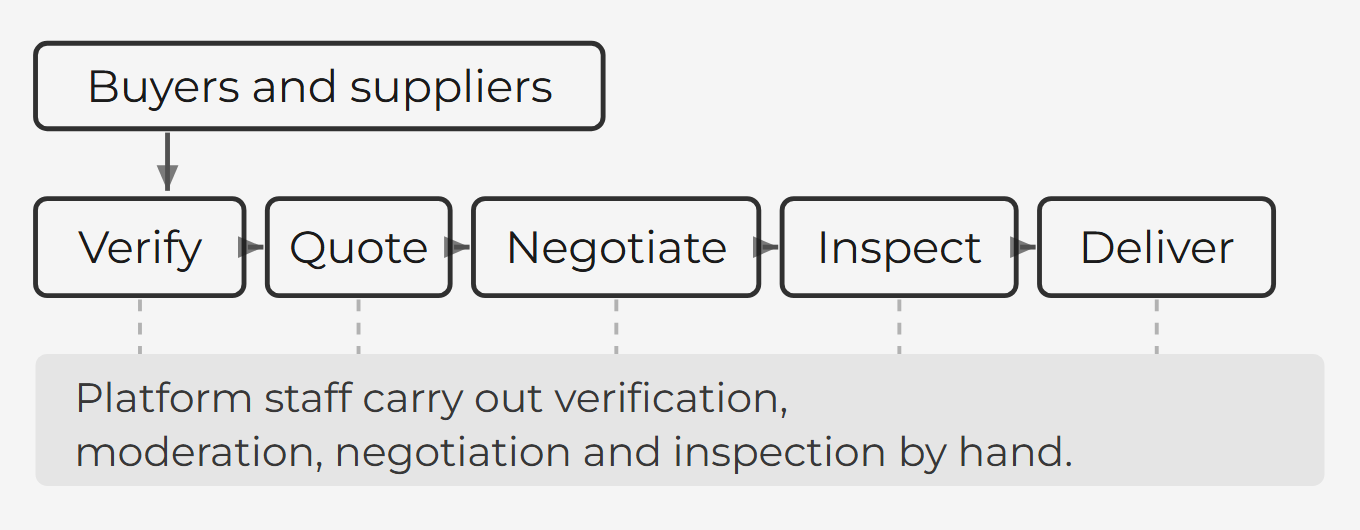
Later work translated the model into detailed flows for buyers, sellers and administrators: registration and business verification, requests for quotation, seller responses, moderated negotiation, contract preparation, escrow coordination, inspection, logistics, delivery confirmation, dispute handling, feedback and audit.
The October 2025 workflow made the operating choice explicit. The minimum viable product would be controlled and manual-first: platform staff would carry out verification, moderation, negotiation, contract work, logistics coordination and inspection, while the digital experience keeps the process coherent for the people taking part. Opportunities for later automation were documented separately, as opportunities. That choice is the substance of the design rather than a shortfall in it — it keeps human judgement where the risk actually sits.
The result
What this work has produced is documented, and can be stated plainly.
A connected body of Business Design work exists: the project framing, the business model, the service-journey planning, the February 2025 market study, the May 2025 review of mission, positioning and platform architecture, the detailed platform and operating design, the manual-first workflow of October 2025, the Gulf market-entry work, the brand and content plan, the Gulfood 2026 activation plan, and the follow-up framework that came after it.
4SOUQ itself moved beyond paper. What exists is a designed hybrid trade service rather than a finished, automated marketplace: it was prepared and presented as a beta at Gulfood 2026, contacts were gathered there, and structured follow-up with those contacts was under way in February 2026. 4SOUQ has its own public site, which sets out the service in its own words.
That is the extent of what the record shows, and this page does not go beyond it.
What this page does not claim
No figure is claimed for this work. The records behind this page do not establish transaction volumes, conversion rates, revenue, market share or return on investment, and none is stated here.
Nor do they establish final acceptance of the complete platform. The six niche markets identified by the 2025 study are research candidates for further evaluation, not markets shown to be profitable. The Gulfood 2026 work is evidenced as preparation, presence and follow-up — not as a commercial result.
If measured results are established later, they will be published with their source, period and method, or not published at all.