
Selected work

Picard Logistics: who decides, and what they see before deciding
A Dubai-based logistics-services business
How a Dubai logistics business organizes work, who decides what, and what management sees before deciding. An ongoing INNOBASE engagement, as at July 2026.
The challenge
This is an operating logistics-services business, based in Dubai. It did not need anyone to build its freight capability. That capability is its own, and it stays its own.
What it needed was for growth and change to be governable. Two things were happening at once. A new country office was being established, and the wider business was working out how to move from conventional logistics activity towards a more integrated, data-informed way of operating. Both raised the same practical questions.
- Who owns each decision, and when does it have to go up?
- How does a contact become a qualified opportunity rather than stay a name on a list?
- How do a request for quotation, partner selection, service buying and selling, a proposal and an order connect into one flow that can be traced end to end?
- What should management actually see before it decides anything?
- Which parts of the current picture are known, and which are assumed?
None of these is a logistics question. Every one of them is a question about how an organization decides.
Our approach
INNOBASE works with the business as a business-transformation advisor. The scope is the operating model: how work is organized, who is allowed to decide what, how commercial opportunities are qualified and followed through, and what management is shown before a decision is taken. INNOBASE does not move freight, operate routes, or run any part of the business’s logistics service.
The relationship is a documented business-transformation engagement, recorded in a signed memorandum.
The work has run in two connected streams. One designed the structure and market approach for a new country office. The other built a transformation and assessment system for the wider business, and then turned it into something people can use day to day.
The result
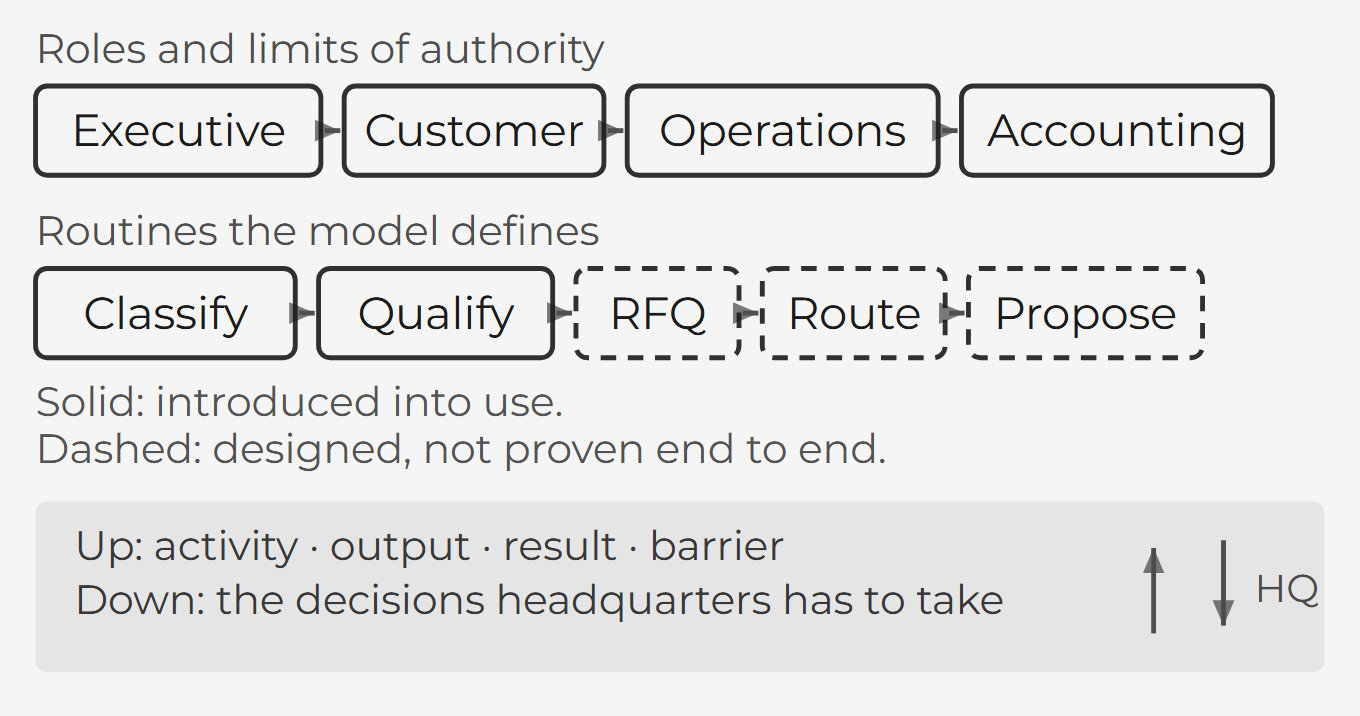
Some of the routines are in use. Office reports from mid-2026 show customer lists cleaned up, customers classified and prioritized, recurring follow-up running, work reported as micro-tasks, and early tracking of quotation requests and opportunities. Selected decisions are being escalated to headquarters in the way the model describes, and management reporting is being written against the framework.
Stated plainly, the strongest result the record supports is this: a broad transformation intention has moved towards a defined operating language and execution architecture, and parts of it have started to be used.
Adoption is not complete, and that is not a caveat added for form. INNOBASE’s own later review of the engagement said so. Standard records are not yet used consistently across the whole opportunity flow. The chain from a lead through to quotation, partner approval, proposal and order is not yet reliable. Decision rights and role behaviour are still settling, data quality still needs control, and the reporting is not yet consistently decision-ready.
Ongoing, as at July 2026. Adoption and reporting discipline continue to mature.
What this page does not claim
No cost saving, lead-time improvement, shipment-reliability gain, customer-satisfaction gain, revenue growth or market-share growth is claimed here. None has been measured in a way that could be attributed to this work, and there is no before-and-after study. The figures that appear inside the transformation playbook are illustrative examples of the method; they are not the business’s measurements and should never be read as such.
The operational execution system and the role manuals have been produced and issued. No record formally accepting them has been found, so nothing here should be read as saying they are accepted, or adopted across the business.
What the work is intended to make possible
The intention behind this work is that real opportunities get qualified faster, that fewer decisions are taken at the wrong level, and that management reporting arrives with the decision already framed and the barrier already named. That is the intent of the design. It is not a measured result, and it is set out here separately from the section above for exactly that reason. If a result is ever claimed, it will come with a baseline, a method, a period and a named population.