
AI that improves decisions — designed, governed, and ready to build
Many organizations have run AI pilots. Far fewer have AI they trust with real work. The pattern is familiar: promising demonstrations, then stalled adoption — because the system was never designed around the decisions it should support, the people accountable for them, or the evidence that would prove it works.
How do you make AI systems governable? By designing them from the business decision outwards: define the value, set boundaries on what the system may and may not do, keep people in charge of what matters, and measure behaviour against evidence before scaling.
Discuss an AI product or decision systemStart from the decision, not the technology
The value of any AI system is decided long before technology choices: it is decided by the quality of the decisions the system is meant to support. So we start from business value — what outcome the organization actually needs — and the decision quality required to reach it.
From there, four commitments define governed design:
- Human oversight by default. People approve what matters. In plain terms: AI does the heavy lifting; your people make the calls.
- Explicit boundaries. The system's purpose, its limits, when it asks instead of answers, and when it declines to act — written down before it is built.
- Governance that names names. Who is accountable for the system's behaviour, and what must never be automated.
- Evaluation before scale. How the system will be tested and measured is defined up front, so its behaviour is judged against evidence, not impressions.
Four layers, designed in order
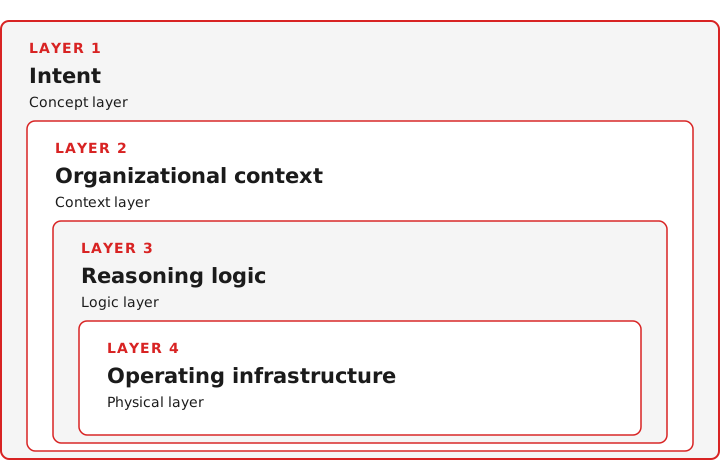
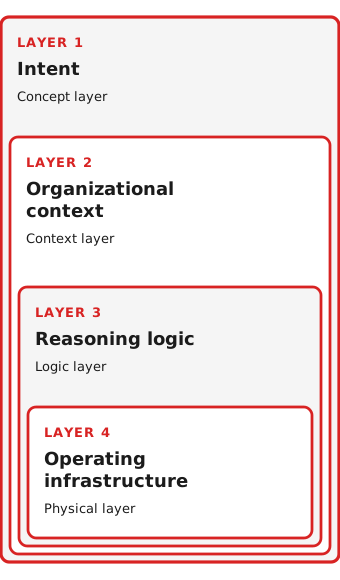
We design every AI product and decision system through four layers, each documented before the next begins:
- Intent — what the system is for: the business problem, the value at stake, and what success would mean. (Concept layer)
- Organizational context — where the system lives: who uses it, who is accountable, what data and constraints apply, and what must always stay with people. (Context layer)
- Reasoning logic — how the system works through a task: the workflow that determines how it reasons, when it asks for clarification, and when it refuses. (Logic layer)
- Operating infrastructure — what it runs on, how it is secured, monitored, and maintained. (Physical layer)
This order matters. Most failed AI initiatives started at layer four.
What an engagement produces
- Intent and value definition — the decision problem and the outcome the system must serve.
- Design charters — documented purpose, context, boundaries, and workflow logic for the system.
- Human-oversight and governance model — explicit approval gates and accountability.
- Evaluation plan — how behaviour will be measured against evidence before scale.
- Implementation-readiness package — a designed, governed, testable system your organization can build, buy, or operate with confidence.
We use this method on ourselves
- Documented charters. Our products carry written design charters covering purpose, boundaries, and workflow logic — the method's artefacts, available to discuss in a conversation.
- Our own governance. The discipline we recommend — evaluation before scale, human approval gates, honest maturity labels — is the discipline we run this firm and this website on.
What we do not show: client AI delivery work is confidential and is not cited here.
How we work with you
A typical engagement moves in three steps. First, a focused framing conversation: which decisions, what value, what risks. Second, layered design: charters for intent, context, and logic, with your team in the room. Third, readiness: governance model, evaluation plan, and a package your builders — internal or external — can implement. Engagements are senior-led and can begin with a single decision system or a single pilot, done properly.
Who this is for
Leaders accountable for AI adoption in large enterprises and government or semi-government organizations; family enterprises deciding what to automate and what must stay human; and any leadership team stuck between AI ambition and AI trust.
Bring the decision you want AI to support
Not the tool you were pitched — the decision. That is where the design starts.
Start a ConversationAlso relevant: Business Design and Business Transformation